
Updated November 2026
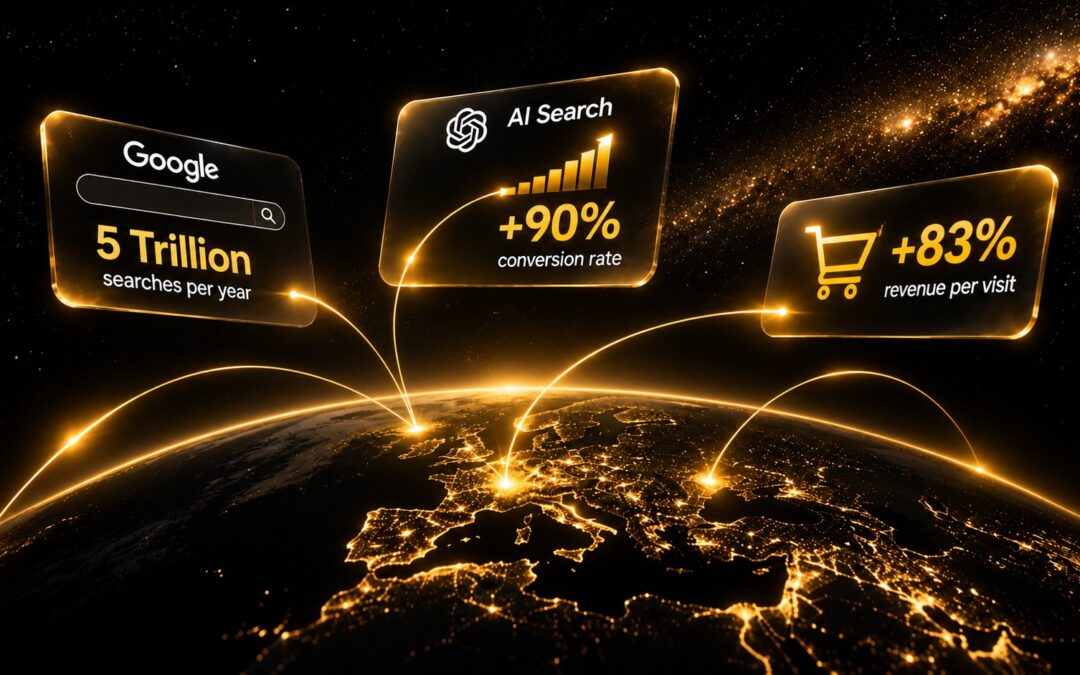
AI-driven traffic generated 90% higher conversion rates and 83% more revenue per visit than non-AI traffic in September 2026, according to Adobe. Meanwhile, Google processes more than 5 trillion searches every year.
These numbers reveal something every business owner and SEO professional should consider: being online is no longer enough. Your business needs to be visible when customers are deciding what to buy and who to buy it from. And increasingly, those decisions involve both traditional search engines and AI-powered platforms.
Here are four statistics worth paying attention to.
1. Google Processes Over 5 Trillion Searches Every Year
According to Google, its search engine handles more than 5 trillion searches annually. That represents approximately:
- 13.7 billion searches per day
- 571 million searches per hour
- 158,000 searches per second
But another statistic makes this even more interesting. Google reports that 15% of daily searches are entirely new, meaning they have never been searched before.
Why does this matter for businesses?
Search demand is constantly evolving. People discover new products, encounter new problems, compare different solutions, and ask questions that did not exist yesterday. A website optimized around a fixed list of keywords may miss emerging opportunities.
The real question isn’t just whether your website ranks today. It’s whether you’re identifying the searches that could bring you customers tomorrow.
Source: Google, 2025. AI, personalization and the future of shopping. Debbie Weinstein’s remarks at OMR Germany.
2. AI Search Traffic Converts 90% Better
Adobe Digital Insights analyzed more than 1 trillion visits to US retail websites. Its September 2026 findings revealed significant differences between visitors arriving from AI-powered sources and those coming from non-AI channels.
| Performance metric | AI-referred vs non-AI |
|---|---|
| Conversion rate | +90% |
| Revenue per visit | +83% |
| Time spent on site | +73% |
| Add-to-cart propensity | +53% |
These are observed differences in US retail traffic, not a promise of the same result for every website. Nevertheless, they reveal an important trend.
Why might AI visitors convert better?
Consider how someone uses an AI assistant. Instead of opening ten websites and comparing products manually, a customer might ask:
- “Which CRM fits a small consulting business?”
- “What are the most energy-efficient windows for a cold climate?”
- “Which hotel booking software offers strong value for a small property?”
The AI assistant can help compare features, identify alternatives, and narrow down options. By the time the visitor reaches a website, they may already have a clearer idea of what they want.
AI search doesn’t simply change how people find websites. It can change how much research they’ve completed before arriving. That makes visibility during the AI-assisted decision process increasingly valuable.
Source: Adobe Digital Insights, October 29, 2026. AI Traffic Drives 83% Higher Revenue Per Visit.
3. AI-Referred Traffic Is Growing — and Becoming More Valuable
According to Adobe, AI-referred traffic to US retail websites increased by 71% year over year in September 2026. But traffic growth isn’t the most interesting part. The change in conversion performance is.
In August 2025, AI-referred visitors converted at a rate approximately 9% lower than visitors from other sources. By September 2026, AI-referred visitors converted 90% better.
This doesn’t mean AI traffic has replaced Google Search or become the largest source of online sales. It means a relatively new discovery channel is showing increasingly strong commercial performance in the market Adobe analyzed.
What does this mean for your website?
A customer might discover your company through Google. Another might find it through ChatGPT, Gemini, or Perplexity. Both could be looking for the same product, but their paths to purchase may be different.
If your competitors are being discovered through AI-powered recommendations and your business isn’t, you may be missing opportunities before customers even visit your website.
Source: Adobe Digital Insights, October 2026. AI Traffic Drives 83% Higher Revenue Per Visit.
4. Many Websites Still Struggle to Communicate Clearly With AI
Here’s a statistic that deserves attention. According to Adobe, the average homepage among the US retail websites it analyzed achieved an AI content readability score of 63% in September 2026. This is an Adobe-specific measure of how effectively AI systems can interpret website content.
It does not mean that 37% of all website content is invisible to AI. However, it highlights an important challenge. A website can look impressive to human visitors while providing insufficiently clear or structured information for AI-powered systems.
For example, imagine a business website with beautiful images and the headline “Innovation for a better tomorrow.” It sounds appealing. But what does the company actually sell? Who are its customers? Which problems does it solve? What makes its products different? Where does it operate? If those answers aren’t clearly available, both visitors and automated systems may struggle to understand the business.
What should businesses do?
Focus on making important information explicit:
- Clearly describe products and services.
- Answer questions potential customers actually ask.
- Explain features, benefits, and relevant use cases.
- Organize information into understandable sections.
- Provide accurate business details.
- Keep content relevant and up to date.
These practices support traditional SEO and can also make content easier for AI-powered systems to interpret. The goal isn’t to write for machines instead of people. It’s to create useful content that both can understand.
Source: Adobe Digital Insights, October 2026. AI Traffic Drives 83% Higher Revenue Per Visit.
5. The Hidden Cost of Being Less Visible Than Your Competitors
Let’s translate visibility into a simple business scenario. Imagine that 1,000 people search for products or services like yours every month. Your website currently attracts 10% of those potential visitors. That’s 100 visits. If your website converts 5% of those visits into inquiries, you receive five potential leads.
Now imagine improving your visibility enough to attract 20% of those searches.
| Metric | Current | Improved |
|---|---|---|
| Relevant monthly searches | 1,000 | 1,000 |
| Share of visits captured | 10% | 20% |
| Website visits | 100 | 200 |
| Lead conversion rate | 5% | 5% |
| Potential leads | 5 | 10 |
Twice as many potential leads — without increasing overall search demand. This is an illustrative calculation, not a forecast of SEO performance. Real search visibility, click-through rates, and conversions depend on many factors.
But it illustrates something important. You don’t always need to create more demand. Sometimes, you need to capture more of the demand that already exists.
And that raises a difficult question: how many potential customers are choosing your competitors simply because they find them first? You may know who your competitors are. But do you know why their pages appear ahead of yours?
- Do they answer questions your website ignores?
- Do they cover topics you haven’t considered?
- Are their product pages more comprehensive?
- Have they identified search opportunities you’ve missed?
You can’t recover opportunities you don’t know you’re losing.
6. For SEO Professionals, Visibility Is One Part of the Job
For SEO consultants, freelancers, and agencies, the challenge goes beyond improving rankings. Clients want business results. They want more qualified traffic, more inquiries, and ultimately more sales. And when it’s time to renew their contracts, they want to understand the value of the work being delivered.
That requires a structured approach: analyze competitors, identify opportunities, prioritize improvements, optimize content, track progress, and demonstrate results. The more efficiently these activities can be managed, the more time SEO professionals can dedicate to strategy.
Better processes don’t replace SEO expertise. They make that expertise more effective. And when clients can see meaningful progress toward their commercial goals, they have stronger reasons to continue investing.
7. Stop Guessing. Start Understanding Your Competition.
The statistics from Google and Adobe point toward the same conclusion. Search remains enormous. AI-powered discovery is growing. And visibility during the purchasing journey can have significant commercial value.
But knowing these trends isn’t enough. Businesses need to understand what is happening in their own market.
- Which competitors are gaining visibility?
- What are they doing differently?
- Which customer questions remain unanswered?
- What should be improved first?
Turn Competitive Analysis Into Action With Emyneo
Emyneo helps WordPress website owners and SEO professionals understand their competitive landscape and identify opportunities for improvement. With Emyneo, you can:
- Analyze your website to identify SEO and content improvement opportunities.
- Compare your pages with competitors to discover differences and potential content gaps.
- Explore how people search to uncover relevant questions and topics.
- Improve content with AI assistance through a structured workflow.
- Review results and reports to support ongoing optimization.
For business owners, the goal is to turn their website into a more effective source of commercial opportunities. For SEO professionals, it’s about working in a more structured, faster, and more precise way to help clients compete.
Your competitors are already fighting for visibility. Do you know what they’re doing better?
Sources and References
- Cited source: Google — Search Statistics and AI-Powered Discovery (2025). Google reports more than 5 trillion searches annually and states that approximately 15% of daily searches are new. AI, personalization and the future of shopping. Debbie Weinstein’s remarks at OMR Germany.
- Cited source: Adobe Digital Insights — AI Traffic and Retail Performance (October 29, 2026). Adobe reports AI-referred traffic growth, conversion rates, revenue per visit, and engagement metrics based on US retail website activity. AI Traffic Drives 83% Higher Revenue Per Visit.
Methodology note: Adobe’s findings primarily concern US retail websites and should not be generalized automatically to every industry or geographic market. The AI readability score is based on Adobe’s proprietary methodology. Differences between AI-referred and non-AI traffic do not, by themselves, establish causation.